

Replacing Back Teeth
Just because you can't see them doesn't mean you won't face problems if your back teeth are lost.
Dear Doctor,
I have been missing one of my back teeth for awhile. My dentist recently recommended that I consider a dental implant or a permanent bridge. Why can't I leave the space alone and not replace the tooth?
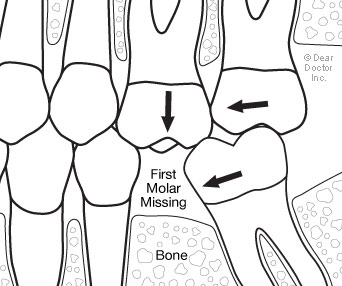 |
| The loss of one tooth can result in the shifting of the adjacent teeth which causes a potential collapse of bite support. |
Dear Mary,
Because missing front teeth are considered aesthetically and socially unacceptable, most people consider their replacement a higher priority than back (posterior) teeth normally hidden from sight. From a dental point of view, however, you should definitely consider their replacement, if not for cosmetic reasons, then for the loss of function created by their absence.
Besides their obvious role in chewing, the posterior teeth affect the overall bite and help ease some of the excessive pressure on the front teeth created by chewing. Dentists generally agree the loss of posterior teeth can lead to a wide array of consequences, especially involving the remaining teeth, gums, jaw muscles, ligaments and joints:
- Decrease in chewing efficiency
- Tipping, migration and rotation of remaining adjacent teeth
- Eruption or extrusion of unopposed teeth
- Excessive wear or erosion of remaining teeth
- Loss of alveolar jaw bone and reduction of the residual boney ridges
- Painful dysfunction of the temporomandibular joints (TMD) that unite the lower jaw with the skull
And, just because the site of the missing teeth is hidden from view doesn't mean there won't be changes to your appearance. For instance, the loss of the posterior teeth can cause a reduction in facial height that becomes increasingly noticeable over time.
Unfortunately, that's only the beginning of problems you may encounter from missing posterior teeth. Some of the above factors, particularly shifting or migration of teeth, can set off a chain reaction that weakens the overall dental system.
When you lose a tooth, the remaining teeth tend to shift at an accelerated rate.
For instance, teeth normally move to maintain contact with adjacent and opposing teeth as natural wear slowly occurs over time (you won't notice this movement because of the equilibrium created by the teeth touching each other). When you lose a tooth, however, the remaining teeth tend to shift at an accelerated rate. This creates a force greater than normal along the tooth, causing abnormal displacement of the tooth in the jaw bone. If these teeth shift too much they may become worthless in the future.
Along the same lines, if the teeth erupt too much there may not be enough room to replace the missing teeth below them. Also, as a tooth moves, it changes the relationship of how the jaw bone is attached to the tooth. This change may leave the tooth more vulnerable to periodontal disease.
Obviously, then, replacement would help deter some of these consequences — but which method is best? Dentists now recognize implants as the best option for replacing missing teeth. They have some obvious benefits: as a free-standing restoration, adjacent teeth aren't usually affected by the preparation process and the replacements are easier to clean and can contribute to the support of the bite.
The most critical factor for implantation is that adequate bone height and volume exists where an implant will be placed. If not, a non-removable fixed bridge is the second best option, although there are a number of considerations to take into account.
First, teeth must be present on both sides of the missing teeth to create a fixed bridge — and you are actually asking two teeth to do the work of three. The adjacent teeth have to be drilled down for bridge placement, so there is a greater risk to the nerves — a future root canal treatment may be necessary. There is also a greater risk of trapped food under a bridge than around an implant restoration.
A third and least favorable option is a removable partial denture. Removable restorations can be difficult to wear and trap more food. Because they are moveable, they may put additional stress on the teeth that hold them in place, which could lead to loosening and loss of those teeth.
In summary, I think you can now see the importance of replacing missing teeth, seen or unseen. Excellent options in dental implants or bridgework are worth looking into and discussing with your dentist.