

Space Between Front Teeth
How muscles (frenums) cause separation of your front teeth
Dear Doctor,
I have a gap between my two front teeth. My dentist says my teeth are separated because of a muscle that runs down between them. I want to have the spaces closed but he says I will need surgery. Please explain further!
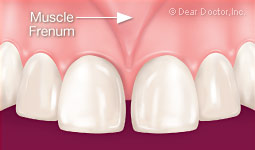 |
| A large muscle frenum often prevents the front teeth from coming together and therefore causing a space. |
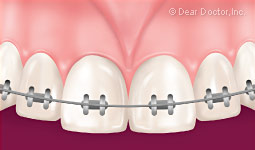 |
| After orthodontics is completed, the space between the front teeth is closed resulting in the muscle frenum being compressed. |
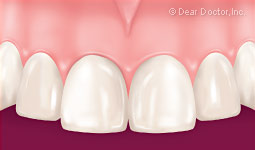 |
| After a minor surgical procedure (frenectomy) relocates the frenum away from the teeth preventing the space from reopening. |
Dear Keith,
You have what is called a large frenum (pronounced “free – num”, or frenulum (fren-u-lum). This is a fold of tissue that connects the gum to the lip and sometimes contains muscle tissue. If it is unusually large it may connect through to the gum tissue between the teeth and extend to the anterior (front) portion of the roof of your mouth, or palate. As in your case, sometimes the frenum attachment extends lower than usual and contributes to a separation of the front teeth, and may contribute to keeping them apart. This does not prevent you from having orthodontic treatment to close the space, but the frenum will probably need to be removed to prevent it from re-opening. Removal of the frenum is called a “frenectomy.”
It is usually preferable to have the situation evaluated by an orthodontist (a dentist who specializes in growth and development of the teeth and jaws and treatment of malocclusions by moving the teeth) or by a general dentist who has special training in this area. An orthodontist can make the correct assessment of the problem, since each individual case is different. Many factors can also be responsible for spacing between the front teeth including: deep bite (excessive overlap of upper and lower front teeth); tongue thrust (from an involuntary tongue habit); tongue or finger sucking habits; bite collapse (following non-replacement of back teeth putting pressure on the front teeth); supernumerary (extra) or even missing teeth — to name a few. The orthodontist can then direct the proper treatment to close the space between the front teeth and decide whether it can be closed by simple movement requiring no more than a retainer, or whether more complex movement is necessary requiring braces. The orthodontist will also decide upon the timing of the frenectomy and whether additional retention will be necessary, such as use of a removable retainer or fixed retainer to stop the teeth from moving apart again.
It is generally better to close the space between the front teeth before removing the frenum, because prior removal can result in scar tissue that can prevent space closure. It is also not a good idea to have surgery before the teeth are moved, because it can leave a “black” triangular hole if too much tissue is taken away; it is also difficult to gauge how much tissue to remove before the teeth are moved into correct position.
Frenectomy is generally an uneventful, small and limited surgical procedure. It is easily accomplished in the right hands, carried out by a periodontist (gum specialist), oral surgeon, or dentist with surgical training. It is performed by locally anesthetizing (numbing) the area and then dissecting out or undermining the frenum tissue, leaving a very small wound, which is usually completely closed with a few stitches. This can either be accomplished with a small scalpel or with a special dental laser, which “paints away” the unwanted tissue leaving only a small wound with minimal discomfort. In either case healing is usually rapid and uneventful and usually complete in a week or so. Any discomfort should be manageable with no more than non-steroidal anti-inflammatory pain killing medication like aspirin or ibuprofen and antibacterial or saline (saltwater) mouth-rinses.
Please speak to your dentist or an orthodontist for more information and advice.