

Whitening Traumatized Teeth
Remarkable results achieved through “internal bleaching”

Dear Doctor,
I read your article on “Whitening” with interest. I had a root canal treatment in a front tooth and it has become darker than the other teeth over the years. Can it be bleached too?
Dear Todd,
As mentioned in the feature article on “Teeth Whitening,” the answer to your question is yes, the technique is known as internal or non-vital bleaching. When a root canal treatment is performed, the root canal itself requires removal of the pulp tissue from the canals inside the roots. As a result, the dentin which comprises most of the tooth is no longer living and often tends to darken over time. This is due to blood pigments left from the pulp removal or sometimes the root canal filling materials.
Today the most common and safest internal bleaching agent used for this technique is sodium perborate.
Bleaching a root canal or endodontically (endo-inside, dont-tooth) treated tooth involves placement of a bleaching agent into the empty pulp chamber of the non-vital, discolored tooth. Today the most common and safest internal bleaching agent used for this technique is sodium perborate.
Sodium perborate is a hydrogen peroxide releasing agent that when mixed with hydrogen peroxide accelerates the rate of color change. In the case of severe discoloration, it is safe to mix sodium perborate with a 3% solution of hydrogen peroxide.
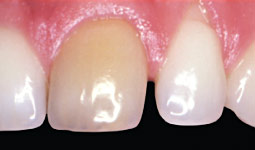 |
| Photograph 1: The above photograph shows a tooth before internal bleaching. Notice the darkened tooth color. |
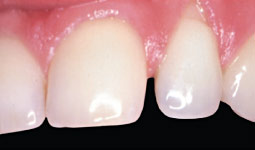 |
| Photograph 2: The tooth is returned to its normal color after internal bleaching. |
| Photos provided by Dr. Alan H. Gluskin |
Clinical stages for internal bleaching — what your dentist or endodontist will do is as follows:
1. Radiographic examination — A radiograph (x-ray) is needed to make sure that the root canal filling is intact and adequately seals the root canal as well as assuring that the surrounding bone is in a healthy state.
2. Preparation of an “access” cavity — a small cavity (hole) is made in the back of the tooth where the original root canal entered the pulp. The pulp space should be completely cleaned of debris and stain. The canal above the root canal filling is then cleaned and irrigated.
3. “Cervical” seal (seal above the root canal filling) — The top end of the root canal filling is then sealed in with a special cement to prevent the bleaching agent from leaking into the root canal filling. This creates a double seal of the root canal space.
4. Application of the bleaching agent — The sodium perborate putty is applied to the empty pulp chamber, covered with a cotton pellet and sealed in with an adhesive temporary restoration. A sound seal is required around the access cavity to prevent leakage of the bleaching agent into the mouth. This procedure is repeated every three to four days until successful bleaching becomes apparent. This normally occurs after one to four visits.
5. Permanent restoration — Once the desired color change has been achieved, a more permanent restoration (filling) which seals the dentin, is required for a successful bleaching therapy. The access cavity is restored with a composite resin (tooth colored filling material) which bonds to the tooth enamel and dentin.
Internal bleaching is a more conservative option compared to restoration with veneers or crowns, but is sometimes used to lighten teeth before the application of these techniques to prevent the discoloration of the natural tooth from showing through. In addition, porcelain veneers or crowns may be required not only to achieve improved color, but also to strengthen a root canal treated tooth.
I hope this answer allows you to have the confidence to improve your discolored tooth's appearance. Thank you for your question.